

There’s a moment I remember vividly from my childhood inner monologue. I was 11 years old, standing in line for the school cafeteria, on the cusp of my elementary school graduation, and suddenly a thought popped into my head.
You know fully and entirely who you are, my 11-year-old brain said. You understand the world. And even if some future self tells you otherwise, always remember what you know at this very moment, right now.
I don’t know why it happened right then — perhaps it was the encroaching of middle school and teen-hood, or my family’s imminent move — but some reason, 11-year-old-me felt the need to protect the person I was then against the judgment of some future Anna. I am a person who knows things, I remember affirming to myself, waiting in line for Wednesday’s spaghetti bolognese. And I’ve never forgotten that feeling, even as I have learned, over the years, just how little I knew and know about so many important things.
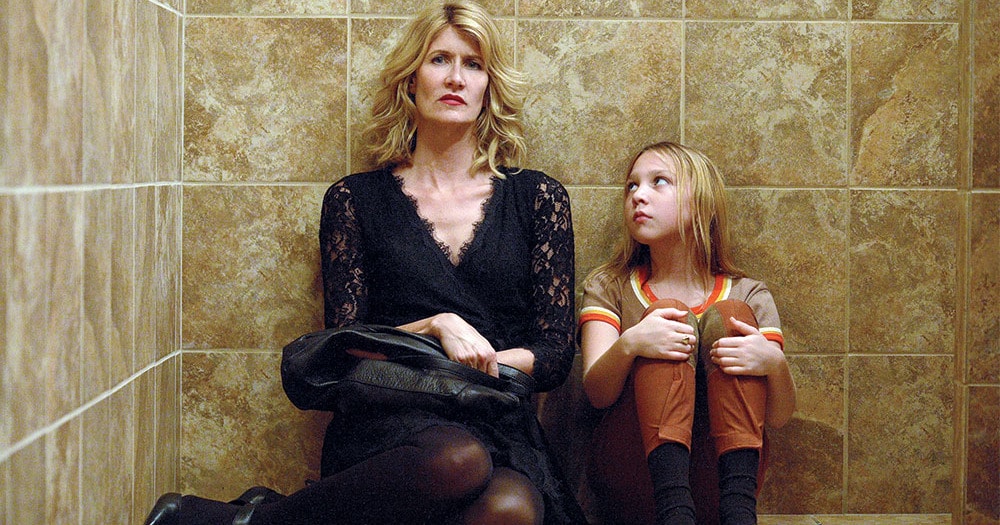
I was reminded of that moment while watching HBO’s The Tale, out Saturday, a film based on the true story of director Jennifer Fox’s life. The Tale captures what it’s like to teeter on the brink of adolescence — and it manages to respect both its young protagonist’s agency and her older self’s sense of justice. The result is an extraordinary exploration of sexual abuse, shaped by the ambiguities of memory and maturity.
In The Tale, Jennifer (played by Laura Dern) must re-examine a ‘relationship’ she had with a grown-up track coach named Bill (Jason Ritter) when she was 13, after her mother (Ellen Burstyn) unearths a short story she wrote about it at the time. When the film opens, Jennifer is convinced the relationship was consensual, describing Bill nonchalantly as an “older boyfriend.” It’s only as she starts to interrogate her past–scrutinizing her own memories and talking to others who were there–that she realizes that she was sexually abused, and that her beloved riding instructor, Mrs. G. (Elizabeth Debicki), helped deliver her straight into Bill’s hands. The film received a rapturous reception at Sundance and has been hailed, like so many feminist cultural artifacts of recent months, as arriving at ‘the perfect time.’ Yet The Tale resists any easy didacticism. Throughout, Fox refuses to paint her childhood self as an unambiguous victim–to treat her as if she doesn’t know who she is or how she sees the world. Instead, she asks how could something she once understood as “ so beautiful” (a verbatim quote from that short story) be so ugly?
“It was my childhood and these things happened to me and it was complicated,” she implores to her boyfriend (played by Common) at one point. “This was important to me, and I’m trying to figure out why.”
There’s one moment, in particular, that serves as a powerful metaphor for the whole project. Much of the film takes place in flashback, as Jennifer tries to disentangle her subjective memories from objective reality. As she begins to reflect back on the past, we see her younger self, Jenny — a poised, statuesque teenage girl with a blonde half-ponytail — arriving at the summer horseback-riding program where she will gradually be groomed for abuse. Thirteen-year-old Jenny looks young, certainly, but her presence isn’t jarring; she looks not unlike the many sprightly ingénues through Hollywood history who have shared the screen with older male love interests. (The actress who plays her, Jessica Flaum, was around 16 when the film was shot). A bit later in the film, the adult Jennifer goes to visit her mom and looks through some photo albums. She points to a picture of Jenny, a smile of relief on her face as she thinks of the summer at camp: “Oh yeah, that’s me.” Her mother corrects her. “Oh no, that’s ’75 — you were already 15 in that picture. Let me show you 13. There. That’s 13.” Her mom flips to a photo of a much, much younger girl — a chubby-cheeked, flat-chested child. Jennifer is horrified. “I was so little,” she gasps. From that point on, her flashbacks feature a much younger actress (Isabelle Nélisse, who was 11 at the time of filming) playing her in flashback. It’s a punch in the gut for viewers, and a perfect illustration of the disjuncture between how we see ourselves and how we look to the outside world.
When I spoke to Fox on the phone, she described the “realization that inside of me I felt so much older” that lay behind her choice as a filmmaker. “How I looked was not how I felt,” she said. “I mean, it’s so shocking how really young I was, and how young I looked. I really, really did look like a 9-year-old boy at 13. I was so undeveloped, and so immature.”
This casting verisimilitude packs an extra punch given the The Tale’s explicit handling of its dark subject matter. For obvious reasons, most films that feature underage sex star older actors — Carey Mulligan, playing 16 and 17 in An Education, was in her early 20s; Bel Powley, playing 15 in The Diary of a Teenage Girl, was too. While there’s a logistical and moral logic to casting adults to play young people in explicit scenes, these choices distort our sense of what teenagers actually look like. (Films like Thirteen, and more recently Bo Burnham’s Eighth Grade, are notable exceptions). Yet, controversially, and in a decision that inspired some Sundance walkouts, the film features does feature scenes of Bill raping Jenny (a disclaimer informs us that an adult body double was used for these scenes).
For Fox, showing the reality of what these encounters looked like was a precondition to making the film. “For me, intuitively I felt, look, this film is about the fact that we cannot look away from what child sexual abuse looks like, and the horror is only in those scenes, it’s only in the crossing the line. And it seemed to me that in most films, it’s at that point that you fade to black or the door closes, and we’re led to imagine. Well, I feel like, for me, we had to see the truth, and truth is horrific. It was not nice. It was not romantic. It was painful. I threw up after each event,” she says. “So for me, it was non-negotiable, and if we were going to make it, they were going to be in, and we prayed that audiences would go with us.”
(Excerpt) Read More at: TheCut.com