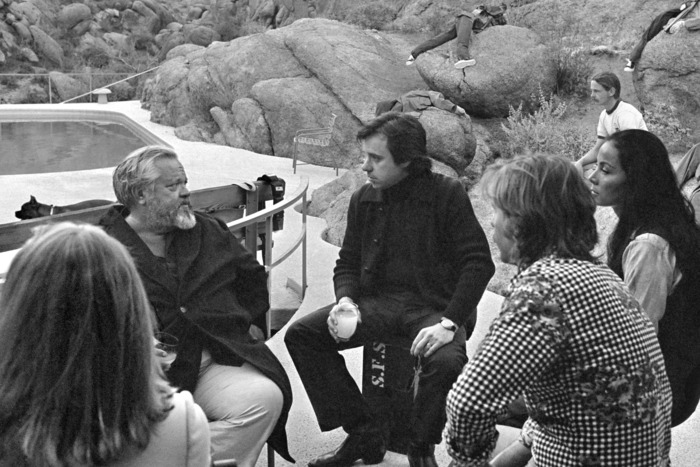
Fictively documenting the filming of a film within a film, Orson Welles’s The Other Side of the Wind casts a grandly meta-narrative eye on Hollywood movie industry insider baseball.
Plotted around the behind-the-scenes sexual predations of an aging filmmaking maverick who’s directing his comeback movie (played by real-life director John Huston), it’s a grandly talky, psychedelic, psychosexual art-house drama, shot on a hodgepodge of different film stocks, from Super 8 to 16 mm to 35 mm, black-and-white to saturated color, to create a kind of kaleidoscopic pile-on of images and narrative voices.
The dramatic mockumentary offers viewers a specific kind of information overload. It’s a time capsule of ’70s excess, peopled with acclaimed directors, including Claude Chabrol, Paul Mazursky, Henry Jaglom and Dennis Hopper — all of whom are essentially playing themselves — with Last Picture Show director and real-life Welles protégé Peter Bogdanovich co-starring as Huston’s character’s protégé (yet another film director). It’s an acidic satire of the studio system, a deliberate mockery of European art films of the day (Michelangelo Antonioni’s Zabriskie Point gets the sucker punch), and an arch commentary on the construction of celebrity (thanks to a goon squad of paparazzi and reporters who film and record Houston’s every move in the movie).
But for Welles completists, The Other Side of the Wind arrives a subject of enduring fascination for an altogether different reason: It’s being touted as his “final” film. It began production in 1970, didn’t finish principal photography until 1976, and reaches the screen some 33 years after the actor-writer-director-producer’s death — an accomplishment requiring no small amount of technological innovation, magical thinking, and legal maneuvering. (Wind premiered at the Venice Film Festival in August, made its North American debut at the Telluride Film Festival in September and begins streaming on Netflix November 2.) One of the film’s producers, Frank Marshall, began working on The Other Side of the Wind in Arizona as a production assistant at age 25, and since the early ’90s has labored tirelessly to complete it. He now feels fairly incredulous — ambivalent, even — that a finished film has finally materialized. “It’s been such a part of my life for so long that it’s a bit bittersweet,” Marshall tells Vulture. “I’m in the place where I say to myself, ‘What do I do now?’”
By the onset of the ’70s, Welles’s professional reputation as the genius auteur behind Citizen Kane had been overshadowed by the received industry wisdom that his days as a commercial filmmaker were a thing of the past — and Welles was his own worst enemy with money, making one catastrophic business decision after another. He’d lived in Europe for most of the ’60s, filming portions of an adaptation of Cervantes’s Don Quixote in Italy and Spain, taking acting gigs in France and Yugoslavia for fast cash, and directing the majority of an adaptation of the Franz Kafka novel The Trial in Paris. When Welles returned to America in the late ’60s, however, he was determined to self-finance his next project: a movie about a hard-drinking, tough-talking, Hemingway-esque director named JJ “Jake” Hannaford (Huston) who returns to Hollywood from self-imposed exile in Europe, determined to make his comeback film, which happens to also be titled The Other Side of the Wind. (Welles insisted the movie was not autobiographical.)
A legendarily chaotic production, the movie is set in and around Hollywood, but its stop-start shoot took place all over: on the Paramount studio back lot; a rented mansion in Carefree, Arizona; Bogdanovich’s Beverly Hills home; Connecticut; Euro stand-in locations including the Netherlands, Spain, and Belgium; and at the Metro-Goldwyn-Mayer studio back lot (which was rented for $200 a day by having the cast and crew pose as film students — Welles is said to have been smuggled onto the studio in a van). Half a scene would be shot in L.A. then be finished two continents away three years later. Croatian sculptor-actress Oja Kodar appears frequently naked as the female lead in TOSOTW, a nameless Native-American radical character. Kodar co-wrote its script, directed parts of the film within the film — a heavily mannered, dialogue-free erotic epic — and also happened to be Welles’s girlfriend at the time.
Throughout the $2.6 million production — originally scheduled for just eight weeks — Welles would halt filming to nip off to shoot other TV and movie projects and commercials to help finance TOSOTW. While also battling his own not-inconsiderable tax problems, he entered into deals with a number of nontraditional film financiers. And one of the film’s European backers legendarily embezzled hundreds of thousands of dollars from its budget. Adding to the already disorientating quality of his guerrilla filmmaking — shooting without location permits, enlisting unpaid film students and interns for the majority of his below-the-line workers — the director encouraged the actors to veer away from the script whenever they felt like it. “John, just read the lines or forget them and say what you please. The idea is all that matters,” Welles is quoted as having told Huston — spawning such dialogue doozies as Huston’s arch assertion that, “It’s all right to borrow from one another, what we must never do is borrow from ourselves!” And a self-serious journalist character asks Hannaford from the back of a convertible, “Is the camera a reflection of reality, or is reality a reflection of the camera eye? Or is the camera a phallus?” (Most of the action takes place at Hannaford’s 70th birthday party, where he screens The Other Side of the Wind for friends, sycophants, reporters, and Hollywood hangers-on on what turns out to be the final day of his life.)
Once the cameras stopped rolling, though, no one could have predicted that the trove of more than a thousand reels of film would not be seen again for over 40 years. In 1975, Welles edited part of the film within the film together to be screened at an American Film Institute lifetime achievement tribute to his work — but also as a kind of sizzle reel for potential investors to drum up funds to finish the movie. That money never came. And The Other Side of the Wind became locked in a legal imbroglio, thanks to a dodgy production deal Welles had struck with the French company Les Films d’Astrophore (owned by none other than Mehdi Bushehri, the brother-in-law of the Shah of Iran). The company attempted to reduce his profit participation in the film and wrest away final cut. Welles, for his part, spent the rest of his life fighting for control of the film and searching for funds to complete it; he died in 1985 at age 70.
In the intervening years, TOSOTW cinematographer Gary Graver, a longtime confidante of Welles, made it his mission in life to finish the movie, only to come up short again and again against the vagaries of French copyright laws, complex ownership disagreements, and grudges among a cast of characters who all claimed some legal or artistic right to control the fate of Wind. After Graver died in 2006, his good friend Frank Marshall — by then one of Hollywood’s most successful producers, behind such blockbuster franchises as The Bourne Identity, Indiana Jones and the Temple of Doom and Back to the Future — took up the torch.
And around 2008, he joined forces with Filip Jan Rymsza, a Polish-born writer-director-producer who first became aware of The Other Side of the Wind by reading a Vanity Fair feature about its legendarily convoluted production. Rymsza took on the crucial task of establishing a chain of title for the film — a historical ownership timeline documenting proprietary rights to an intellectual property — spending roughly four years conducting audits and combing through records to assemble a 300-page document cataloguing every historical rights transfer.
(Excerpt) Read More at: Vulture.com