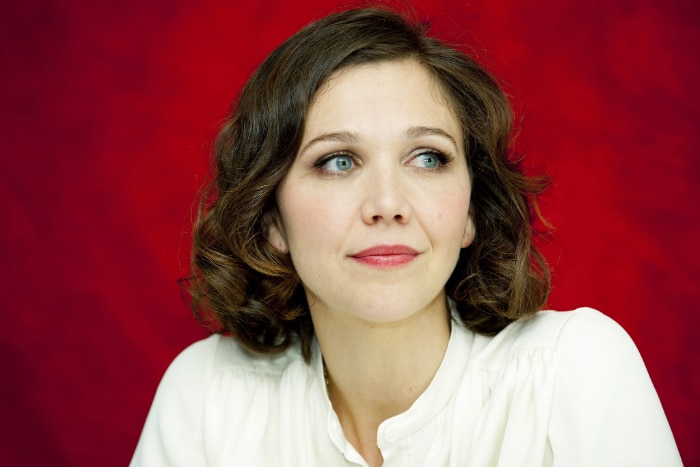



“I’m not interested in showing the wish of what it looks like to be human,” says Maggie Gyllenhaal. “I’m interested in showing what it actually looks like.”
That’s exactly what the actress has done with her work as prostitute turned porn auteur Candy in the current season of HBO’s The Deuce and as the emotionally desperate title character in The Kindergarten Teacher, the latter of which begins streaming October 12 on Netflix and is already earning Oscar buzz for its star. Though Gyllenhaal’s approach — always humane, always intelligent — has remained steadfast since she broke out with 2002’s Secretary, lately she says, “something in myself — it’s hard to say exactly what — has shifted.” That shift, as well as a great many other things — from her excitement about telling fully feminine stories to the controversy over her Deuce co-star James Franco — is what we discussed over lunch at a quiet Italian restaurant in Manhattan’s West Village.
I assume that, like everyone else, you watched the Kavanaugh hearing. What were you thinking and feeling about what you saw?I wept through a lot of Dr. Ford’s testimony. I was coming back to New York from L.A. while the hearing was happening and listening on the way to the airport. When I got there I rushed to the airport lounge to keep watching, and then I was able to stream it on the plane. I didn’t anticipate how consuming I’d find it. I missed a bunch of work stuff I was supposed to do because I didn’t do anything other than watch. I found it shocking how little performance there was to her testimony.
In contrast to Kavanaugh?I wasn’t thinking about it in contrast to Kavanaugh; Kavanaugh had a different job to do. I don’t think we often see people in the kind of spotlight that Dr. Ford was in who are so lacking in a performance aspect. Even though it was difficult to watch, to see somebody being so human in that moment felt so moving.
I’m wondering if there are connections between your feelings in that regard and your work. I’ve been thinking about this, too. My work does relate to it. What I’m trying to do, even though I’m an actress performing, is create something human and not performative. Because what’s underneath a performance is what’s most vulnerable, most human, most interesting. And we aren’t fed a lot of that. Instead we’re told what it looks like to love or what a powerful woman looks like. And a lot of times that’s an oversimplified fantasy. I’m compelled to explore the opposite of the fantasy.
How much of your interest in behavior is about going inside and understanding yourself and how much is about wanting to communicate outward with other people?I get magnetically pulled towards a project because there’s something in it that offers me the opportunity to explore the edge of my understanding about myself. But then, also, don’t you find with your closest friends that what’s compelling you at a certain moment is also in compelling them? As a culture, as a community, we’re often thinking about similar stuff.
The Zeitgeist is a real thing.Right, exactly. The Kindergarten Teacher is an example: I’ve sat through two screenings and been there for the end of a few more, and hearing the reaction of people watching that movie is really interesting — the laughter, and people gasping at the end when it takes its first turn and when it takes its second. I feel like there’s something happening in this movie that’s new, and I think people don’t make noises like the ones I’ve heard in the screenings otherwise.
Can you pinpoint what that new thing is?
There was something in The Kindergarten Teacher in the way that [writer-director] Sara [Colangelo] wrote it that was feminine, and I’ve been thinking a lot about what that means. Wait, I have organize my thoughts all the way from the beginning to explain myself here. So I went to the dentist probably six months ago. I had a bunch of cavities to be filled and I was nervous. I like to listen to something if I have to go to the dentist and I’d forgotten—Sorry, you listen to headphones while you’re in the dentist’s chair? That’s a great idea.Yeah, and I remember Nick Cave had a new album out the previous time I was at the dentist and I listened to that.
Nick Cave seems intense for the dentist’s chair.
[Laughs.] I had been listening to him, yeah. God, I take good care of my teeth and it doesn’t fucking matter because I always have cavities. Anyway, I was going to the dentist and I didn’t have anything to listen to. While I was in the waiting room I went to Audible to see if I could find something and they were advertising the audiobook of Juliet Stevenson reading Virginia Woolf’s A Room of One’s Own. I listened to that for this long dentist appointment, and I was interested in this idea about halfway through the book of how difficult it is for a woman’s “whole and entire” feminine experience to be expressed because we’re living in a fundamentally masculine world. She [Woolf] uses [Charlotte] Brontë as an example and says that Brontë is an amazing writer, but she’s so angry — understandably so. She’s hiding her writing paper underneath her sewing at the table. She’s full of rage and sadness. All that clouds her writing. I was fascinated by that. Just because a woman is writing doesn’t mean hers is a fully feminine piece of work. Sorry, can you tell I had a lot of coffee today?I’m glad you did!
Yeah, so what I’m getting at is that because so much of the culture that’s out there is fundamentally male, most women’s muscles for relating to masculine art and making it feel personal are very well exercised. I’m glad to have that muscle but when I was in high school and saw The Piano I was like, Whoa. Watching that movie was a different experience. I didn’t have to do any switching to understand that film. Or reading Elena Ferrante and going, What she’s explaining is so fucked up and then going, Hold on, I totally relate to it. The comfort and connection that you feel by seeing your experience purely expressed is unusual for many women. I apologize if I’m monologuing.No, no. Go on.And I felt when I read the script for The Kindergarten Teacher that it was a pure expression of something feminine. In a way the movie is an exploration of the consequences of starving a vibrant woman’s mind, told from the point of view of women filmmakers. And our conclusion is that the consequences are fucking dire! I do think there’s something new about that.
Is it possible to achieve a fully feminine work of art if men play a key part in its creation?
Mm-hmm. As long as you’re working with people who are curious and interested about the reality of the characters’ experience. The Honorable Woman was an expression of the feminine experience and it was written and directed by a man who was an interested, curious artist [Hugo Blick]. And The Deuce is a mixture of feminine and masculine expression. There were times when I would say to George [Pelecanos] and David [Simon], “Look, this is what I’m trying to express here,” and they would say, “I don’t understand.” I’d explain what I meant and I could feel it was different from what they had intended but they were still interested.Can you think of a specific example of that kind of back-and-forth?
I have a good one from the new season. In episode three there’s that blow-job scene. As we were working on it, David said, “I think she should walk out.” And I was like, “I don’t think she should. I think she’s got to do it.” Otherwise she’s kind of a superhero. Almost every woman can relate to doing a much more subtle version of what Candy is being asked to do in that scene — acquiescing in a way they wished they hadn’t. And that could be a lot of things. Maybe it was laughing at a joke that was totally inappropriate. To actually give the blow job, I think, is much more rare. But if Candy walks out, you lose everyone’s understanding. Anyway, we all agreed on that but what I really advocated for was for her to give the blow job and then to have a moment alone after. George said to me, “I don’t totally understand the trajectory. She’s conflicted but decided to give the blow job. Then you have the moment alone with her where she looks quite upset. Then the moment in her apartment where she’s almost triumphant. It’s very difficult to put a finger on exactly what’s happening with her there.” And I said, “I don’t think it goes from A to B to C. I think it’s a very feminine trajectory. She has a lot of feelings about what she just did.” That’s what I love about it. And we kept it in.You said earlier that the roles to which you’re drawn are the ones that let you explore the edges of yourself. What’d you get to edges of with The Kindergarten Teacher and The Deuce?
I only finished shooting The Deuce a few weeks ago, and it takes a little distance from having done the work in order to be able to analyze it. I don’t know. I know I could probably go beyond that answer for you.(Excerpt) Read More at: Vulture.com