


It seems almost unthinkable that The Meg is based on a book. After slews upon slews of terrible mutant-shark movies from the likes of SyFy and The Asylum, the notion of such a film being adapted from a written text – with a high budget! – is quite something.
But Meg: A Novel Of Deep Terror indeed exists, published in 1997 and written by author Steve Alten. It has spawned six sequels about its giant prehistoric shark so far. And now, after decades of development hell, a movie.
Spoilers ahead for both The Meg and its source novel(s).
The Ultimate Battle
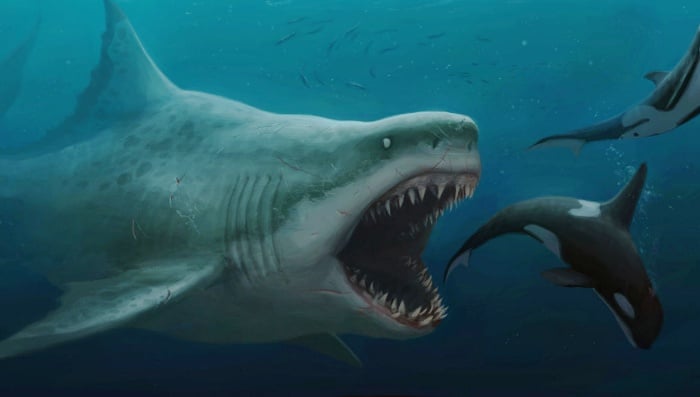
For starters: Meg opens – opens! – with a fight scene between a Megalodon and none other than a Tyrannosaurus Rex. It’s staged almost like the opening from Jaws: the Rex is chasing a pack of hadrosaurs when they flee into the water. Chasing after them, the predator gets stuck, unable to swim as well as its prey. Then the prey in question suddenly disappear, before the Rex itself is attacked by the titular giant shark. Cue extreme, bloody shark-on-dino violence, which the shark comprehensively wins (obviously).
The image of a T-Rex being thrashed about and turned to a gooey mix of seawater and gore is a powerful first impression, obviously setting up its beast to be the new apex predator of the prehistoric world. It would have been totally bananas to see on screen, but also would have cost a dime and a half to produce. Given how frugal the final film is with full shots of its monster, it seems unlikely that an elaborate, entirely CGI sequence involving the shark and multiple dinosaurs would have ever been on the cards. A shame: it’d set up the Meg’s prehistoric origins (even if the period depicted isn’t fully accurate), cause cheers to erupt from the audience, and give a firm middle finger to fellow 2018 blockbuster Jurassic World: Fallen Kingdom.
A Few Smaller Omissions
Obviously, a number of other changes were made in the journey from page to screen. Protagonist Jonas Taylor, a paleontologist and marine biologist in the books, became a deep-sea rescuer with the body, face, and voice of Jason Statham. Japanese characters are recast as Chinese, and San Diego as China’s Sanya Bay, thanks to the involvement of Chinese production company Gravity Pictures. Jonas’ ex-wife is a marine biologist in the film, whereas the book – not the most charitable towards women – casts the character as an ambitious journalist who is eaten by the Meg while trying to film it through a shark cage.
Several setpieces and story elements also changed or moved around in the act of adaptation. The film’s opening sequence, in which a downed submarine is destroyed by the Meg, is taken from the sequel book The Trench – as is Jonas’ romance with his Japanese (now Chinese) colleague’s daughter. The Meg itself glows in the book, its bioluminescence presumably a reflection of its deep-sea habitat. It also eats, in addition to a healthy number of surfers, a helicopter – a SyFy-worthy stunt missing from the film. Narrative-wise, though, the biggest difference is that the film’s Meg isn’t pregnant. In the book, the impending birth serves as a ticking clock plot mechanism, and the resultant baby Meg is captured for scientific study – and for sequels. A surprising change, given Hollywood’s thirst for franchising, but easy enough to retcon into the film’s climactic feeding frenzy if need be.
None of these omissions, however – not even the T-Rex scene – can possibly live up to the utterly bugnuts sequence that takes place at the book’s climax. Strap yourselves in.
(Excerpt) Read More at: SlashFilm.com