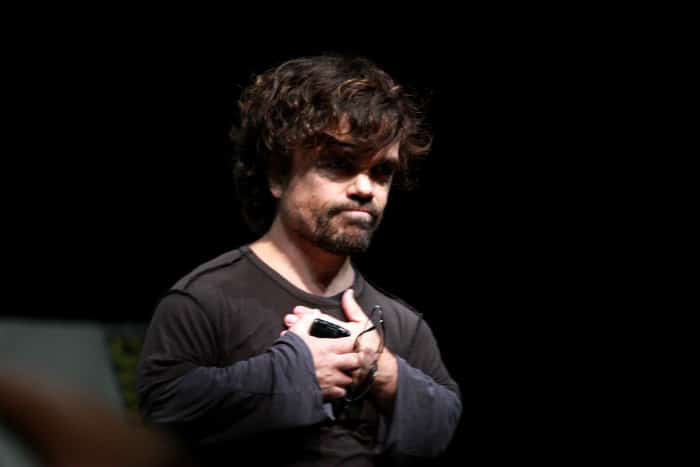



In a hotel room high above midtown Manhattan, Peter Dinklage is discussing, among other things, his present — that’d be HBO’s My Dinner With Hervé, in which he plays the late Fantasy Island star Hervé Villechaize.
(Based on a real-life encounter between Villechaize and writer-director Sacha Gervasi, the TV movie premieres on October 20.) And on the sidewalk down below, a group of fans is waiting, clutching mementos of his past. That is, they’re hoping the actor will sign their Game of Thrones memorabilia when he leaves. (The show, in which he plays Tyrion Lannister, wrapped shooting its final season this past summer.) “I take more of an issue with fame than Hervé did,” says the 49-year-old Dinklage, who’s aware of the ways in which Villechaize’s celebrity was a precursor to his own. “It’s a dance, but one you can never really control. As an actor, the best you can do is try to bring some honesty into your parts and hope people will follow.”
What did Hervé represent to you when you first became aware of him?
Well, Hervé and I had nothing in common but our height, but I remember thinking, He’s underused. I’d become aware of him around the same time everybody else did: I saw Fantasy Island. It was a wild show, like a combination of The Twilight Zone and The Love Boat. And I’d seen The Man With the Golden Gun. Later, when I became a teenager, my thinking about him got translated with a bit more anger, like he was being used a certain way because of his size. But the funny thing is, I think I minded that much more than Hervé did, because he seemed to have genuine joy in being on Fantasy Island. And who was I as a young person living in New Jersey to judge that? Hervé was complicated, and this was the first time I’d ever played someone who’d been a living, breathing person. It challenged my judgments.What were those judgments?What’s the saying? “Walk a mile in someone else’s moccasins?” It’s funny talking to a journalist. No offense, but I’m really only here because I believe in this project and I want people to see it. But I think Hervé loved this ethereal idea of fame. And what is that idea? It’s an abstraction. Children are asked, “What do you want to do when you grow up?” And they say, “I want to be famous.” They don’t have a concept of, well, famous for what? And when that desire [for fame] becomes bigger than the work itself, it’s very dangerous. Hervé was this incredible painter; he could have had the most incredible career. But because of his size, he was spotted and given this comfort zone of fame and being in exotic locations with beautiful women. I’m being careful with what I say because I speak from my heart with genuine love and affection for this man. I worked on this role for 14 years, and I never figured Hervé out. He’ll always be out of my reach.
From a technical acting standpoint, how difficult was it to handle the aspects of your performance that involved impersonation? No one else on earth had Hervé’s voice.For the first time ever, I worked from the outside in. Hervé and I have a similar nose, but everything around our nose is different. And if you have the same nose, you don’t have to do as much to the rest of your face. So we did “less is more” with the makeup. We just tweezed some eyebrows and put cheek-plumpers in because Hervé had big, round cheeks. The voice was more complicated because even if you don’t know who Hervé was, you know what “ze plane, ze plane” sounds like. I knew if I couldn’t get that then I shouldn’t play the role. It was important to me to get it, and it eventually came.
What you were saying about Hervé’s idea of fame and its relationship to his gifts as a painter — can you talk a little bit more about the tension between fame and nurturing one’s talent? And I mean both in Hervé’s experience and your own.I think perhaps fame was controlling Hervé. You have to be in charge of yourself and tune everything else out. It’s getting harder to tune things out because of social media and everybody knowing everything about everyone. Growing up, I didn’t know anything about my favorite actors. Marlon Brando, Meryl Streep, Alan Arkin — I didn’t know what they had for breakfast. But now it’s like, “Look what I had for breakfast!” And you don’t really want to know because it chips away at the magic of the character they’re portraying.
Do you really think so?
For sure. Not knowing about the actor helps in believing in their performance. I worry about actors revealing what’s behind the curtain. Yes, I’m talking to you here, but we’re talking about a project. I wouldn’t even imagine beginning to talk about my personal life. It’s no one’s business. That’s my life. You lead yours. Hopefully that won’t kill your questions six through seven.I do have some questions about you, but not about your family. I’m hoping you can answer them.So it’s questions 6 through 19! [Laughs.] But fame is about other people’s idea of you. Much like Hervé did with [Fantasy Island’s] Tattoo, I had the honor and privilege and joy of playing a very popular character for many years. I just finished that. When I leave here today, by the time I get home, I’ll get something yelled at me ten times: something from the show [Game of Thrones], my character’s name [Tyrion Lannister]. All things considered, ten is not that much, given that there are millions of people outside on Fifth Avenue. And for the most part, it’s done with joy. But it’s this thing of that’s what you are. That’s what Hervé was: Tattoo. “Ze plane, ze plane.”
What’s the line that you get?
“I drink and I know things.” It’s strange: There are tattoos of Tyrion. But Tyrion is also me, so people have tattoos of my face on them. It’s like, “Oh, okay. You made that choice. It has nothing to do with me.” Sorry, I think I got off track.No, that was all on track. I remember reading the New York Times Magazine article about you, and in it you referred to people following the “white balloon” of fame and money. So how conscious are you of not doing the thing that Hervé arguably did, which is pursuing things that would get him money and fame at the expense of his true gift? What’s the calculus for that?
It’s a great question. I don’t know what that compass is. Personally, I just love a great script. Box office is out of your control; you’ll never please everybody, and I’m attracted to works of art that divide people. If everybody loves something, are you doing something right? I mean, everybody loved the Beatles, but it doesn’t always work that way. Actually, not everybody loves the Beatles — there are like three people who don’t, and they’re just being contrary. I know we’re going to keep talking about fame, but it’s the theme of the film [My Dinner With Hervé], so it’s very important to grapple with. As soon as you feel hurt on a personal level because people whom you don’t know don’t like you anymore, that’s a tragedy.There’s an interesting book about Hervé by a guy called Scott Seldin, who wrote about their friendship and living the bohemian life together in New York in the early ’70s. Reading it, you never get the impression that Hervé’s goal was to be an actor.No.
So was it just circumstance that got Hervé into acting? And I was curious about how you got into it because —It’s about owning who you are. Hervé had ownership about his size. He was going to wear it brightly. And becoming an actor, that’s probably one of the reasons I do it: I get to command it [people’s attention] a bit more, and be in control of it through characters — stand in front of it. You know, for most of the movie, I wear a T-shirt that says “bionic midget.” That’s such a complicated shirt. Hervé walks into the room and you go, “Hey, look, he’s wearing that shirt. Cool. He’s having a sense of humor about it.” He’s beating you to it. But it’s also a really fucking angry shirt.
Were you aware as a teenager of the idea of acting as a way to own the attention you were getting? Or did you only realize that later?I think probably I was aware of it. Not wanting unwanted attention but commanding it on my terms. I don’t know. It’s hard to trace back the psychology. What goes through a kid’s mind? But it’s about having your hand on the dial. You’re turning it up when you want and turning it down when you want. As an actor, you can do that. And for someone the least bit physically different, I guess you want to be in control of that dial. But as a kid, I just loved the creative joy of acting and, yes, the attention — on my terms.
(Excerpt) Read More at: Vulture.com