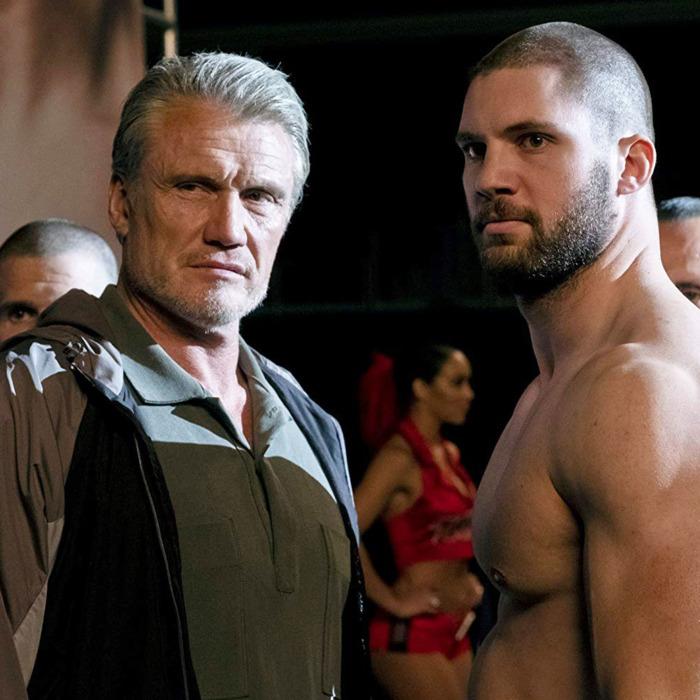



Dolph Lundgren feels misunderstood. “I’ve been taken for granted. I’ve suffered: physically because of all the films I had to do; psychologically from my dad, and from people thinking I’m a big, blond thug with no emotions who can’t act.”
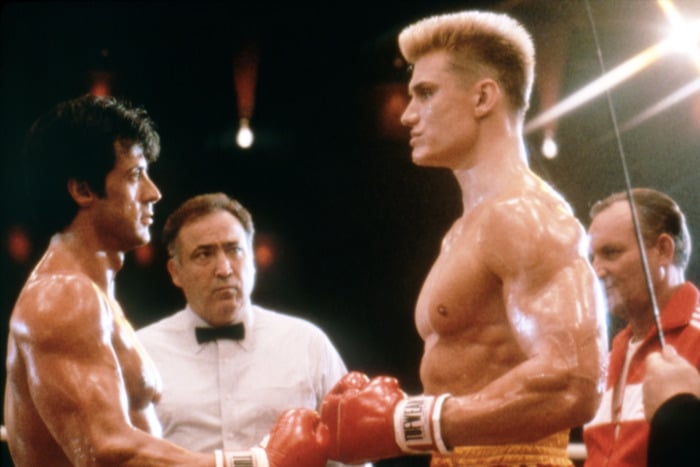
It’s not a mode one expects from this mountain of a man. The 61-year-old is, after all, one of the most prolific and iconic action-movie actors of his generation. He has more than 80 film credits to his name, largely playing warriors and killers. He was He-Man. He was the Punisher. He was an Expendable. But, perhaps most important, he was Ivan Drago, the Soviet pugilist who nearly bested Sylvester Stallone’s title character in 1985’s Rocky IV. In that film, Drago seems cold, bloodthirsty, driven, merciless — anything but vulnerable.
Then again, maybe we just didn’t get to know Drago well enough. We certainly didn’t get to know Lundgren well enough. Ever since his turn as Drago cemented him into celluloid history, people have made assumptions about the actor. They think that he’s Russian, that he’s dumb, that he’s talentless. In actuality, he’s Swedish. And he has a master’s degree in chemical engineering. As for the talent bit, well, that’s in the eye of the beholder. But with roles in two big-deal Hollywood pictures in as many months — Creed II and Aquaman — Lundgren is hoping he can prove to the world that he’s more than a Nordic beast. He’s ready to be one of those former stars who stages a comeback as a dramatic performer in middle age. If he has his way, the Lundgrenaissance will soon be upon us.
He has to convince the world that he’s ready for that kind of career shift, but before that, he had to convince himself. In Creed II, Lundgren returns to the Rocky Cinematic Universe and reprises his role as Drago, a role that has been both his calling card and his burden for more than 30 years. “When I first got the text from Stallone two years ago, he said” — and here Lundgren slips into a perfect Stallone mumble-grumble — “‘Hey, wanna play this guy again?’ And I was like, Oh, shit. Drago.”
Yes, Drago. Rocky IV was only Lundgren’s second acting credit ever, but his performance etched itself into the cultural consciousness and changed his life forever. Just a few years prior to the ’80s classic’s release, even the idea of being in a movie would have seemed completely alien to the man. Born in Sweden in 1957, his father was an engineer and, in Lundgren’s telling, physically and emotionally abusive toward him in his youth. Nonetheless, the boy strove to prove he could succeed in the family business. An accomplished scholar athlete, he studied the sciences in Sweden and the United States throughout his teenage years, then earned his master’s at the University of Sydney and was awarded a Fulbright scholarship to study at MIT.
Then a chance encounter changed everything. While in Sydney, Lundgren worked a side-hustle as a bouncer and one night found himself working a Grace Jones concert. The art-pop legend noticed the towering, almost unsettlingly handsome Lundgren and invited him to spend the night with her. He eagerly complied, and the two were soon an item. She suggested that he decamp to New York City with her and start his life anew; he said yes to that, too. I ask him if there’s some part of him that regrets giving up science and taking a chance on this wild new existence. He pauses. “A very small part,” he says. “I wasn’t 100 percent sure it was the right decision, but I didn’t want to go to MIT. I knew in my heart that I didn’t want to do that for the rest of my life.”
In place of that path, a new one appeared, littered with glitter and intoxicants. All of a sudden, thanks to Jones, Lundgren was hanging out with the likes of Andy Warhol, David Bowie, and Michael Jackson. Jones brought him on set while she was shooting the James Bond picture A View to a Kill, and at her suggestion, he tried out for a bit part and was cast as a KGB tough named Venz. He took acting classes and learned that Stallone, then one of the most famous men in the world, was looking for someone to play his rival in the next Rocky flick. Out of a reported casting pool of thousands, Lundgren got the part and stepped into the ring as the character that would become hisbête noire.
In Rocky IV, we don’t hear much from Lundgren. Most of the time, when we see Drago, he’s being talked up by his wife Ludmila (Brigitte Nielsen) or his trainer Nicolai (Michael Pataki). Drago, himself, simply towers and glowers. On the rare occasions when he does speak, the audience perks up and remembers his words. When he savagely beats Rocky’s pal Apollo Creed in an exhibition match, giving him mortal injuries, Drago flatly tells journalists, “If he dies, he dies.” When he’s about to fight Rocky in the climactic match in Russia, he stares our hero down and calmly intones, “I must break you.” Of course, the good old American can-do spirit takes Drago down in the end, and when we last see him, it appears that the Soviet politburo is deeply unhappy with his loss.
Late–Cold War audiences in the U.S. were quite happy to develop a lovingly hateful relationship with the character, and Lundgren was abruptly thrust into the spotlight. Lead roles in Masters of the Universe (that’s the He-Man movie), The Punisher, and Universal Soldier followed. Then, in the ’90s, the wheels fell off. He found himself stuck in the same sort of parts over and over again, playing dead-eyed killers in movies of decreasing quality, and eventually getting stuck in a direct-to-video purgatory. What’s more, he was partying too hard and gradually ruining his marriage to fellow Swede Anette Qviberg. “I made a lot of mistakes and I had a lot of traumas from my childhood that I let run me and run my life,” he says. “It’s called escape behavior. I was doing crazy physicalities and fighting and stunts and drinking alcohol and having affairs. You’re trying to escape that trauma, but you can’t.” As the 2010s dawned, Lundgren was a classic case of “where are they now?”
Two things happened. First, Stallone called him up and got him to join the cast of The Expendables, putting him back on the blockbuster map. Second, a post-marriage girlfriend encouraged him to start meditation and therapy — he was resistant, but after the relationship fell apart, he gave it a try. The dual practices allowed him to deal with the legacy of his father’s abuse for the first time, and the results were profound. Ever the performer, he achieved an apotheosis by delivering a TEDx talk in 2015. “The way out is through,” Lundgren says. “I had to speak about it publicly.” The transformation had a tremendous impact on his professional prospects and has brought him to a place where he could feel comfortable taking meaty roles again. “I couldn’t have done this ten years ago,” he says. “I had too many hang-ups, too much crazy energy.” Now, he was ready.
(Excerpt) Read More at: Vulture.com